Monday, 14 October 2013

Prabhu Yesu Mahotsav or Mission Congress 2013

Prabhu Yesu Mahotsav or Mission Congress
11-13 October 2013, Ranchi
Dignitaries and participants from fourteen dioceses of BIJHAN for the Yesu Mahotsav arrived on 10th October. The participants were boarded in various houses such as: Albert’s college, Ursuline High school, St. Ann’s High School, SDC, St. Aloysius High School, ASPUNJ, JHARNA and other houses. In the evening at 6. O'clock. Very Rev. Ignace Topno, the Vicar General of the Ranchi Archdiocese Celebrated the Eucharist. This was followed by the Supper in the Albert’s College ground.

11 October 2013
Theme: “I am the Light of the World”
His  Eminence Telesphore P. Cardinal Toppo celebrated inaugural Mass at 7 O’Clock in the morning along with several other Bijhan Bishops: Very Rev. William D’Souza S.J., the Archbishop of Panta, Very Rev. Felix Toppo S.J., Bishop of Jamshedpur, Very Rev. Anjelus Kujur, Bishop of Purnea, Very Rev. Kurien Valiakandathil, Bishop of Bhagalpur, Vey Rev. Vinay Kandulna, Bishop of Khunti, Very Rev. Paul Lakra, Bishop of Gumla, Very Rev. Vincent Barwa, Bishop of Simdega, Very Rev. Anand Jojo, Bishop of Hazaribagh, Very Rev. Julius Marandi, Bishop of Dumka,  Very Rev. Sebastian Kalapurackal, Bishop of Buxur and over 200 priests.  Cardinal Toppo in his homily exhorted the faithful to be the disciples of Christ. He said, “to be the disciple of Jesus is the greatest gift of God.” By living as sons and daughters of the light we exhibit ourselves as light to others, that others may see the light of Christ and glorify God.

H.E. Telesphore P. Cardinal Toppo, 
breaking the Word of God


H.E. Telesphore P.Cardinal Toppo 
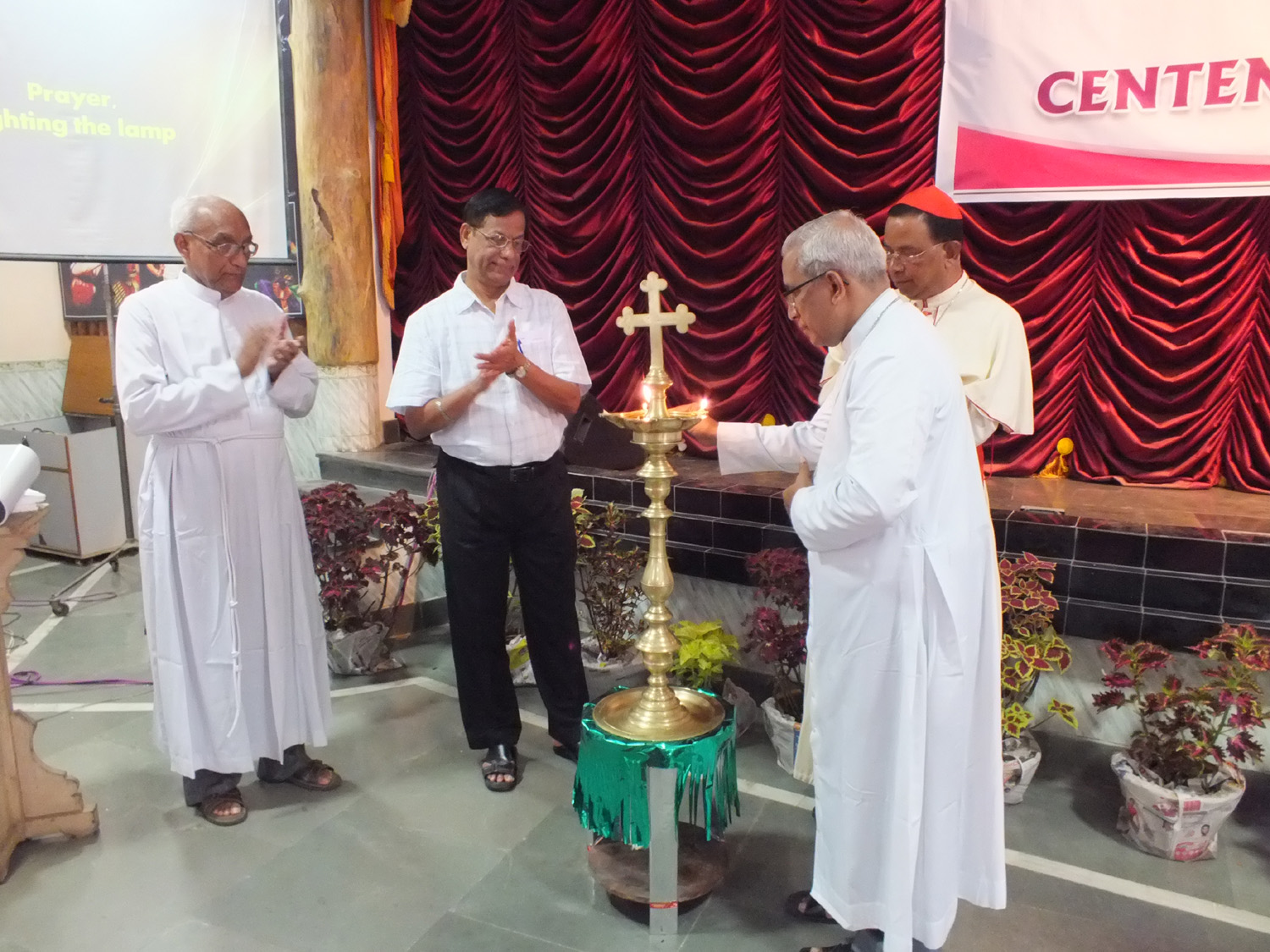
Lighting the Lamp
Archbishop William D'Souza 
Lighting the Lamp
Archbishop William D'Souza 
Honouring the Word of God
Bijhan Bishops and 
Fr. Prasad Pinto Ofm Cap
The formal inauguration was done soon after the breakfast.  All the dignitaries were honoured with a flower bouquet and a badge by the Youth of Ranchi Archdiocese. Mahila Sangh assisted in lighting the lamp. Delegates of Church Hierarchy were invited to light the lamp. Accordingly, Cardinal Toppo and Archbishop William D’Souza as Bishops’ Delegates, Very Rev. Fr. Joseph Prasad Pinto OFM Cap as Priest delegate, Sr. Kirti of Bhagalpur from Religious delegate, Mr. Rajan of Patna as Men delegate, Mrs. Mariam Mark of Betiah as Women delegate, Mr. Kuldeep Tirkey of Ranchi and Miss Teresa Murmu of Dumka as Youth delegate lighted the lamp. This was followed by “Bible Procession.” After the enthronement and veneration of the Holy Bible in a decorated place on the dais, Bishop Kurien Valiakandathil hoisted the flag of Bijhan Mission Congress. Bishop Paul Lakra then released a bunch of Balloons.
Bishop Paul Lakra 
releasing baloons
colourful cultures 
and dioceses of Bijhan
Ursuline Novitiate sisters came up with a prayer dance and Konka Siram Toli Youth Welcomed the gathering with a Nagpuri Dance. This was followed by welcome address by His Eminence Telesphore Cardinal Toppo. Reiterating the message of Pope Benedict XVI, he said, “We want this Year to arouse in every believer the aspiration to profess the faith in fullness and with renewed conviction. It will also be a good opportunity to intensify the celebration of the faith in the liturgy, especially in the Eucharist. At the same time, we make it our prayer that believers’ witness of life may grow in credibility. To rediscover the content of the faith that is professed, celebrated, lived and prayed, and to reflect on the act of faith, is a task that every believer must make their own, especially in the course of this Year.”
Albertine Brothers 
Praising God in the Choir


Bishop Vincent Barwa delivered the presidential address in the charismatic style. In his address he exhorted the people to be the light of the earth. He said, the purpose of the light is to dispel the darkness. The theme, “light of the earth” is taken from Sermon on the Mount. This teaching has been accepted by everyone in the world irrespective of culture and creed. Christ’s mission and vision is for everyone.  Today, in India we are threatened by several antisocial elements such as terrorism, consumerism, poverty, violence and corruption. In such situations, Jesus tells us, “Let your light shine.” Quoting Bible he said, “I have made you light of the world so that through you the message of salvation would reach to the ends of the world.” There is light in everyone’s life. Let everyone through their good works take their shining light to the people who are suffering and fill their life with faith, love and joy and become ‘light to others.’ When we think good of others, when we live Christ’s value in this corrupted world our light shines more.
Bishop Vincent Barwa, 
exhorting the people
Mr. Oli Minj then read out the Hindi Translation of the letter of the Archbishop Salvatore Pennachio, the apostolic Nuncio. In his letter, the Nuncio congratulated the entire church of Bijhan for organizing this event. 
Archbishop William D’Souza S.J., the chairman of the Bijhan Bishops, expressed his joy and welcomed all the participants and prayed for its success. This was followed by a short tea break. After this, the youth animated in theme song and a few action songs.
Front View
Mr. A.V. Jose, a lay person from Patna Archdiocese was the resource person for the first session. He is the present national director of the “Couple for Christ India,” and a Charismatic preacher in Patna Charismatic group.  He spoke on the theme, “I am the light of the world.” In his speech he said, that Jesus was invited in the Marriage feast at Cana. He went there and fulfilled their needs. In the similar way, if we do not invite him in our daily endeavour, we become his enemies. If we invite him, he will come to us and pour ‘grace upon grace.’  We are the salt of the earth. Christians are minorities in India. Still this minority is sufficient to bring saltiness in India. When we accept Jesus in our life, we will receive his grace and become channels of grace for others. Every moment of our life we are called to be in union with Jesus Christ as we pray, “Give us this day our daily bread.”
Mr. A.V. Jose 
It's the Meal time
Sumptuous Lunch
Line for Food
Mothers' Love:
distributing Lunch
Queue please!!!!
 A sumptuous lunch was followed by witness session. Mr. Vijender from Patna shared his faith experience. Through his experience he stressed that ‘there is nothing impossible for God.’ Mrs. Lucy Singh, a Buddhist convert from Jamshedpur through her heart-touching experience gave a powerful witness to Christian faith.  After this session, the whole house was divided into 64 different groups. Basing on the inputs given on the day, they were asked to share their faith experience and give witness within the groups. When this was done, the reports were co-ordinated by their respective dioceses. Representatives shared their report thereafter in common.
People behind the scene


People behind the scene


People behind the scene
Eucharistic adoration along with the Sacrament of Reconciliation was conducted before the supper. Thereafter, diocese-wise cultural programme was conducted on the theme, “how the light is shining in your diocese.” Seven dioceses participated in this event.

12 October 2013
Theme “You are the light of the world”
As yesterday’s was theme, “I am the Light of the World”, and today the second part of the theme was taken, “You are the Light of the World.” The day began with Morning Prayer led by the Ursuline Sisters of Ranchi. After the breakfast, the session began with the action song, “Cast your burden Unto Jesus.” The youth and choir animated this session. Then, Sr. Eva Justin OSU, Provincial Superior of Ursuline sisters, Ranchi elegantly summed up the activities of previous day with a short reflection.
Cast your burden Unto Jesus
Then began the input-session. Fr. Vinay Guria CDF, was the main speaker of the day. Rev. Fr. Cyprian Kullu, the Vicar General of Gumla Diocese, and the moderator of the session introduced the speaker and the theme of the day. In his introduction he emphasized the words of Fr. Lievens, “Fire Must Burn.”
Fr. Vinay Guria CDF
Fr. Binay Guria in his speech emphasized on three aspects of faith: renewal, living and sharing one’s faith. He then explained the concept of YESU MAHOTSAV, a concept internationally known as Mission Congress. The six main goals of this Mission Congress are: 1. Strengthening one’s faith, 2. Understanding the rights and duties regarding evangelization, 3. Becoming aware of the needs of Mission, 4. Witnessing Christian Faith, 5. Life in union with the Catholic Church and spreading the gospel of Christ in the whole world, 6. Strengthening  the Local Church. Fr. Guria based himself to his booklet which was published for Year of faith, “Vishvas Varsh” which contains an explicit description of strengthening one’s faith.
After the tea break Rev. Sr. Sudha Lakra SJT, shared her faith experience. She belongs to the congregation of St. Joseph’s of Tarbs (SJT) and at present working in Jamshedpur Diocese. She narrated a number of events from her life, when she experienced the divine love and care. She narrated her vocation story and how she re-evangelized herself when she realized the divine providence in her life. When God intervenes, He topples-down our life and situation. Whatever is given by god, is given with love. Whatever God does, He does it for good. Narrating an incident from the life of Late Sr. Elisaba, her vocation promoter, she said, “In our Defeat Lies our Victory.”
Action planning
August gathering 
praising God
August gathering 
praising God
August gathering 
praising God
At. 11.45 a.m, began the Holy Mass. Very Rev. Felix Toppo, the Bishop of Jamshedpur Diocese presided over the Holy Eucharistic Celebration. Very Rev. Anjelus Kujur S.J., the Bishop of Purnea proclaimed the Gospel. Bishop Toppo broke the Word of God. In his sermon, he emphasized the truthfulness and love of Jesus. The life, death and the sacrifice of Jesus is true. Jesus is thirsty for our love. To know Jesus we have to live a holy life. There is a need to develop our moral standards today. There is an urgent need to put an end to the consumerist attitude which prevents us to go ahead on the way to God.
Afternoon session was dedicated for the Diocese-wise group discussion and action planing. Mr. Benjamin Lakra presented some points for the discussion. Before the discussion could begin, there was a heavy rain which obstructed the session. But, St. Albert’s College proved its generosity by providing class-rooms, refectories and auditorium for the success of the event. After an emergency meeting of the administrators, it was decided that the further proceedings of the Mission Congress would be held in the Albert’s College and Cathedral. Volunteers rushed to the seminary and with the help of seminarians classrooms, refectories and auditoriums were made ready. The scheduled ‘action plan session’ took place without any trouble. Soon after this session, all gathered in the Cathedral and under the guidance of Mr. Benjamine Lakra, the representatives of each diocese presented their ‘action plan.’
group discussion 
and action planing
group discussion 
and action planing
group discussion 
and action planing
group discussion and action planing


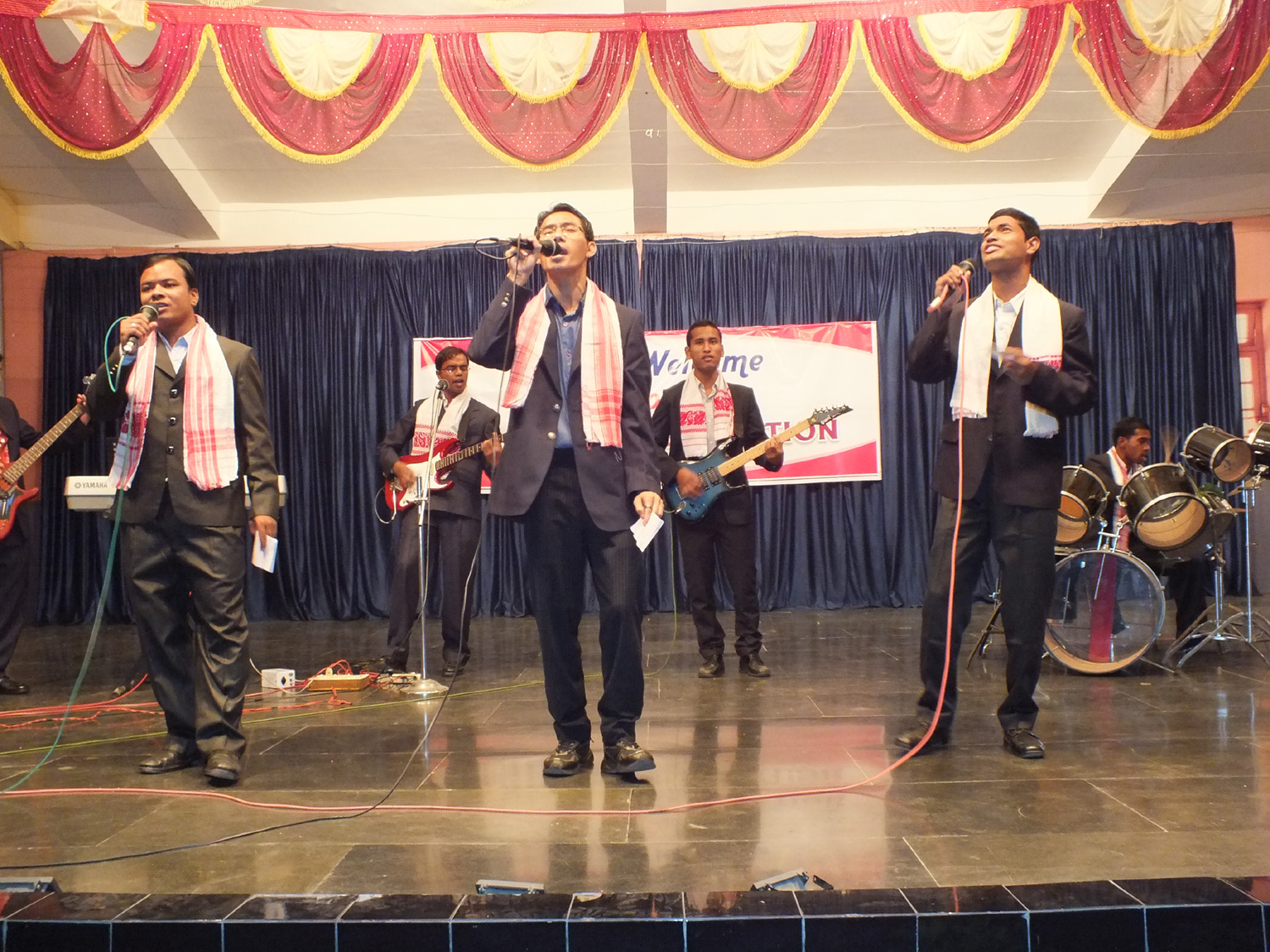
The evening cultural program was held in St. Albert’s College Auditorium due to the bad weather and wet ground. 
evening cultural program
13 October 2013
Theme “You are the light of the world”
Due to torrential rain, scheduled programme could not take place in Loyola ground. Therefore, it was held in the Cathedral. After the breakfast, Sr. Linda Mary summarized yesterday's programme elegantly. This was followed by the Eucharistic Celebration, presided over by His Grace William D'souza, the Archbishop of Patna and Concelebrated by Cardinal,  other bishops and priests. Thus, three day's Mission Congress was a grand success. 

SAC Football ground 
as food court


SAC DARPAN team 
Documenting


SAC DARPAN team 
Documenting


Blog prepared by: SAC DARPAN team
Photography: Raju Felix Crasta

Monday, 16 September 2013

Centenary Alumni Re-Union, 11-12 September, 2013


11th September, 2013

“To accomplish great things, we must not only act, but also dream, not only plan, but also believe.”                      Anatole France 

Ever since St. Albert’s College started forming and training priests for the Kingdom of God, it not only acted according to the mandate of Christ, “Go and Proclaim,” but also had dreamt of Kingdom values; not only planned its course of formation but also was enabled to believe in the Kingdom. And today, those priests, proud of having sown the seeds of the Kingdom of God all-around the world for the last One Hundred Years, are here back in their alma mater and exclaim, “How nice it is to be here.”

Here, as students, some of them underwent formation for four years, some three, some two, some 10 or more. Not only they gained knowledge here; they also fructified the knowledge gained in various fields. In its fruition, they climbed the rags of the ladder, higher and higher. Today, St. Albert’s is proud to count on the blessings in terms of thousands of priests it trained, 35 bishops and a Cardinal which it gifted to the Mother Church. It is a “homecoming day” for them. Dear fathers, “St. Albert’s was your home, is your home and will be your home for ever.”

Bothers were busy in assisting the alumni to register their names and address on 11th morning. Every alumni was given an ‘alumni bag’ with necessary things needed for various sessions.

This was followed by the inauguration of the Alumni Re-Union. It was held in the auditorium. Fr. Rector, His eminence Telesphore P. Cardinal Toppo, and Rev. Fr. Abraham Puthumana S.J. lighted the lamp.


Fr. Joseph Prasad Pinto OFM Cap., the Rector, welcomed the gathering with affection and humility.
Rector, Fr. Joseph Prasad Pinto OFM Cap. 
Thereafter, the Rector exhorted the dignitaries, the alumni and others in the following way:

As we began to prepare for this Alumni Gathering on the occasion of the Centenary of our St. Albert’s College, we had made a list of all the priests, who had passed out from this College and sent our cordial invitations to each one of them through their respective Bishops or Major Superiors. We presume that our invitations have reached all of them. In fact, many enthusiastically expressed their interest to come to this Gathering but expressed their inability to do so due to unavoidable circumstances. It is also possible that several Alumni did not receive our invitations for reasons beyond our control. We deeply regret this fact.


 All of you have come here with fond memories and powerful experiences of your student days. With nostalgic spirit you are at your Alma Mater St Albert’s College. This College was established in 1914 with only 6 seminarians. The number of seminarians had been rather small till 1950, on average about 30 of them each year. But with the subsequent growth in Catholic population and the construction of spacious buildings, the number of seminarians steadily grew to 100 in 1957, 170 in 1970 and around 300 in recent years. However, since a few years the trend seems to be a steady decline in priestly vocations all over; and that has affected our College too. Over 40 dioceses and 20 religious congregations benefit from this premier institution in some way or other. From its inception the seminary was fully managed by the Society of Jesus till 2002 when it was entrusted to the Board of Bishops of Bijhan - Bihar, Jharkhand, and Andaman. More than 2000 priests have come out of this seminary, out of whom 36 have become Bishops, some Archbishops and one Cardinal. We may say that this premier Ecclesial institution is the power house and the nerve centre of Christian faith-formation and Christian Faith-renewal in this region.

Historically the local Church here had its origin from Lutheran Mission begun in 1845, Anglican Mission in 1868 and Jesuit mission in 1869. Thus the local Catholic Church here is only about 144 years old.  Yet, by and large, we may boldly say that the Christian Community in Chotanagpur today has become formidable. Christian Community’s growth, and its Gospel commitment and contribution to the Universal Church and society at large are keenly felt all over India and even abroad. Many of the local Christians, priests and nuns have begun to cross the local geographical and cultural boundaries and have reached other parts of India and the world; they have established their strong Christian presence in places like Andaman, Jalpairguri, Tezpur, Dibrugarh, Bagdogra and several other parts. Thus the little flock of Chotnagpur has become the Biblical leaven in the mass of India. Today the Catholic presence in North India is significant only in the tribal belts of Chotanagpur and North East. About 15 percent of the Christians of India are found in these regions. One has only to travel a little in the remote areas of Chotanagpur like Gumla, Simdega and Jashpur. One will be pleasantly surprised to see even the remotest tribal areas dotted with small and big churches, convents, hostels for the poorest boys and girls, children going to schools and the faithful returning from the churches. Among the most well known Catholic institutions of this region are: the Jesuit run St. Xavier’s Autonomous College, Ranchi; XISS, Ranchi and XLRI, Jamshedpur.

And you yourselves, the honoured Alumni of this College, have taken the Good News of Jesus to several other parts of India. You are indeed the Fruit, the Joy and the Fulfilment of this College and God’s Glory. You are here to refresh your lived beautiful memories of Seminary days, to celebrate your priestly life and empower your life of ministries in Jesus.


Session One: Key note address

The Rector's welcome address was followed by the key note lecture. The resource person for the day was, Rev. Fr. Abraham Puthumana S.J. The Master of Ceremony Fr. John Crasta introduced the resource person. The topic for the day was, “Challenges to the priestly life in the Present Modern World.” The following is the excerpts of the talk delivered by Rev. Fr. Puthumana.
Rev. Fr. Abraham Puthumana S.J
The basic challenge of priesthood is to share in the ministry of the Church to build itself into the People of God, Christ’s Body and the temple of the Holy Spirit. This means that the priest has to be aware of the unchangeable aspect of his life, namely he must resemble Christ. He should be able to contextualize himself viewing himself from today’s society and the church. Today people are deeply aware of human dignity; there is the thirst for justice and peace, a more lively sense that humanity must care for creation and respect nature. There is the thirst for God and an active meaningful relation with him.

On the negative side, the challenges are as follows;
Rationalism: Rationalism at work can make a person insensitive to an encounter with the divine transcendence. Many would not think of anything beyond the here and now, that is the lived reality of the world. There is the all pervading search of pleasure that again locks a person into himself/herself without feeling any need for God. Distorted sense of sexuality leads to break up in families in many parts of the world. There is hesitation to accept the magisterium of the Church and often this results in superstition and religiosity without God.

Fr. Puthumana delivering key-note address
Subjectivism in matters of faith makes one clank to what pleases him/her. The almost compelling pull of consumer culture which glorifies “having” over “being”. Hence the struggle to amass oneself, be it money, material things, degrees, qualifications and so on, to the neglect of the growth and development of the inner being. This is particularly true in the area of sexuality.

There is a thirst for freedom, authenticity and sincerity. There is search for a more just and sympathetic and united world. We can see in many parts of the world various forms of voluntary service especially with regard to the poor.  In many countries the materialistic ideologies have collapsed.

There are challenges arising from ethnicity. Often the question of one’s caste or tribe is raised and a person is accepted or rejected on the basis of family or group origin. [This is very much seen] again when it comes to appointment to some important offices in the diocese itself or appointment of bishops.

Would it be right for me to say that the basic problem here is that priesthood has become a career and not a vocation to serve God and the people? In the course of study and/or priestly ministry such persons may have lost their original vision and inspiration for entering into priestly way of life.

The challenge today for the person would be to go back to his original call and rediscover the roots of his call; and for the believing community to expose such personal career / ambitions on the part of the priest who initiates conflicts.

Unless we go back and rediscover what it was that prompted us, in the first place, to accept this call we are surely going to get into a three-fold struggle for power, prestige and possessions. Today, these three Ps keep many priests in bondage and these are at the bottom of many conflicts in the dioceses and religious congregations.

Another problem is the tendency on the part of some priests and religious to appropriate what belongs to the parish or community for the benefit of oneself or one’s own family. This happens when one makes one’s own the goods belonging to the parish or gives them to one’s own family.

Multiculturality among the clergy is another challenge facing our churches. If a multicultural clergy group is able to rise above ethnic considerations the situation will be a powerful lived witness to the power of the Risen Christ that can bring people of various cultures and languages to work together for the establishment of God’s Kingdom in today’s world.

The Laity complain of the lack of preparation on the part of some of the celebrants. There is hardly any preparation for the liturgy or the celebration of the sacraments. The homilies are not prepared and they instead of being inspiring become a hurdle to the faithful in their worship.

Both the positive happenings and the conflict situations described above pose challenges to the priest of today.

Holy Eucharistic Celebration

Decorated altar
After the tea break, Con-celebrated Holy Eucharist was held. Most Rev. Thomas D’ Souza, Archbishop of Calcutta was the main celebrant and homilist. The theme of the mass was, “Remembering the departed souls of Albertine family.” The chapel had a bridal look as all the alumni had vested in uniform colours.


I cannot narrate here the feelings of each and every priest here. Some were emotional, some were joyful and some overwhelmed. Some wanted to capture unique moments in the camera and some videographed their memories. The joy of celebrating together was great that many priests were left teary-eyed.

Group Discussion

In the afternoon, group discussions were held. The whole house was divided into twenty groups. Each group was given four questions to discuss. The questions were as follow:
a. Looking back at your experience of ministry since the time of your ordination, do you feel that you have given sufficient time to study the evolving world situation so as to be more effective in your ministry?
b. On a scale of 1 to 10, how would you rate your continued study and updating of your theology, spirituality and pastoral skills? Have you made consistent effort in all these areas? If so, what – diocesan structures, personal initiatives – have helped you to grow continually?
c. If the answer to the above question (n.2) is negative, what would you suggest that we do to correct to this shortcoming both at the personal level and at the level of the diocese? Make concrete suggestions.
d. How could your alma mater, St. Albert’s Seminary, help in the continued spiritual and theologico-pastoral growth of the alumni?

Groups were spread in the whole seminary. Every class room, library and hall were occupied to discuss the issue. This way, again the alumni re-lived their student life.


Colourful Cultural Evening

Most Rev. Paul Toppo conducted the evening prayer. By means of a colourful  and meaningful slideshow he lead us all to the divine. It lasted for 20 minutes. After this we had a colourful cultural programme.
Most Rev. Paul Toppo
The Sister students of the college came up with a meaningful prayer dance. This was followed by various other programmes by brothers such as Nepali dace, Kharia dance, Karam dance, Santhali dance, Bhojpuri and Bangra dance.


In the meantime, distinguished alumni were felicitated. One of the prominent alumni was, Rev. Fr. Xavier Toppo.
Rev. Fr. Xavier Toppo
addressing the gathering
He joined the Albertine family before independence and is a priest for over five decades. He was invited to the stage and was felicitated by Fr. Rector. This was followed by bishops and jubilarians.

Sumptuous dinner was served at the SDC, Ranchi.


12th September, 2013

The day began with the solemn Eucharistic celebration. His Eminence Telesphore P. Cardinal Toppo was the main celebrant. Bishops Francis Kalist of Meerut Diocese, and Thomas D’Souza, were among other concelebrants on the altar.


Holy Eucharist, presided over by Cardinal Toppo
Soon after the Mass, we had the group photo session. Photos were clicked as a whole group, and also in various smaller groups, besides many more interested parties.


Reporters were ready with their camera and interview. Local TV channel was recording every movement.

 Key note address of the day
At 9.00 a.m, began the first session of the day. Rev. Fr. Sebastian Tirkey was the resource person. The theme was “Relevance of the Seminary Formation in Today’s Socio-Pastoral Context.” The following is the excerpts of his address:
Fr. Sebastian Tirkey
According to the Albertine calendar, many subjects and topics have been taught in the seminary by the competent professors. The calendar indicates the all round development of the Seminarians. It is a very good sign for the growth of the future priests. In olden days some of the courses were not present explicitly (like accountancy, project planning, youth animation etc) but implicitly. However, I am in a dilemma whether the insights given by the professors are really grasped by the students or studied just to pass the examinations.

In olden days, much stress was laid on prayer life, pastoral work and forming of good parish priests. It seems with this changing world the priests of the modern age do need prayer and pastoral formation. They need the intellectual insights and degrees. The pastoral life becomes the secondary matter.

It is becoming difficult to get good parish priests and good assistant parish priests in this modern age. Good priests are fit for any type of work.  Drinking habit is increasing among the clergy. Some priests are becoming alcoholics and it is a problem of the dioceses. Such priests work for worth Rs. 5. 00 and the diocese has to spend Rs. 500,000.00 for their treatment. If a seminarian is found in taking an alcoholic drink, he should be sent out from the seminary without any excuse. There is no need of asking or informing the respective bishop.

In spite of all the short-comings of priests, the faithful respect the priests. Therefore, I request the seminary staff to train the future priests as men of pastoral concern and to be responsible to the assigned duties.

This  was followed by an open discussion. Many came forward and expressed their views. All were very much grateful to the seminary staff. They gave several suggestions to make the seminary a ‘model seminary’ in the world.

Reporting session
Reports of the group discussion held on the previous day were placed in this session. All the twenty groups elegantly presented their views.


Vote of Thanks

At the end of the programe, Fr. Rajesh Minj proposed the vote of thanks.


Fr. Rajesh Minj proposing vote of thanks
The Masterminds
Fr. Jacob T.K was the main co-ordinator of this Alumni Re-union Programme along with Frs. Rector, Michael Ignatius, Deepak Tauro, and Rajesh Minz. 

Fr. Jacob TK, the Chief Coordinator
Fr. Deepak Tauro
Fr. Michael Ignatius, the Minister
Man-of-the-Match and Man-of-the- Series
Months of preparation and effort turned the finale a ‘grand success’. Fr. Raju Felix Crasta was the official media person who recorded every action of the programme.


Fr. Raju Felix Crasta, Media and Photography
Rev. Fr. John Crasta, the professor of Moral Theology and alumni effectively anchored two days programme. 
Fr. John Crasta, Master of the Ceremony


Report and photography by,
Fr. Raju Felix Crasta


For more pictures: click below:
https://picasaweb.google.com/112747257174044050675/AlumniReUnion1112September2013?authkey=Gv1sRgCOyVudbH1Njn7gE


Recipe for success: Study while others are sleeping, work while others are loafing, prepare while others are playing, and dream while others are wishing.”  
                              William A. Ward

Dreams are renewable. No matter what our age or condition, there are still untapped possibilities within us.”
                             Dr.  Dale Turner