Sunday, 10 July 2016

JESUS, THE FACE OF THE MERCIFUL FATHER

© This is a  summary of the Schola Brevis by Dr.Fr. Antony Samy, the Professor of Scripture at St. Albert’s College Ranchi, on the occasion of the inauguration of the Academic Year 2016-17, Delivered on July, 2016 at SAC Auditorium, Ranchi, Jharkhand.

JESUS, THE FACE OF THE MERCIFUL FATHER

INTRODUCTION
Dr. Varghese Kurien’s (1921-2012) compassionate approach: An employee stealthily drinks milk ... Rule: every employee be given half a litre of milk to drink while she/he is at work. He displays his heavenly Father’s face of mercy” (A. Thottakara, W & W 49, 2016, 1).
Since Pope Francis’ election, his simple message of mercy, service, and renewal has spread to every corner of the world. His Apostolic Bull (Misericordiae Vultus [MV], “The Face of Mercy”) opens with these words “Jesus Christ is the face of the Father’s mercy,” identifying the core of “the mystery of the Christian faith.” Mercy is a concrete reality through which God reveals his love as father or a mother, moved to the very depths out of love for their child. It has become living and visible in Jesus of Nazareth. Mercy is a person (Heb 1:1-2; Jn 1:14,18).
A person’s face conveys a lot: their facial expressions; their mood, their responses, their attitudes and their demeanour. In other words, a face is an outward expression of an internal reality; it’s what makes the invisible, visible. As Pope Francis points out, “In Jesus Christ, this mercy culminates in so great an act as to hold back nothing to save us, not even death on a cross.”

1. CONTEXT FOR THE JUBILEE YEAR OF MERCY[1]
Digitalized and dissipated world, consciously and consistently seeking after varied ‘M’s: Money, Modernity, Mobility, Manufacture, Management, Multiplicity, even Manipulation. In this scenario, Mercy is mercilessly dismissed and conveniently ‘thrown away’ (J. Rosario, NL 10). The Year of Mercy is apt and appropriate for our turbulent and terror-stricken world, inviting us to adopt a compassionate and merciful approach.
Pope Francis called this particular Extraordinary Jubilee of Mercy to direct our attention and actions on mercy so that we may become a more effective sign of the Father’s actions in our lives ... a time when the witness of believers might grow stronger and more effective (MV 3; K. Poovathumkudy, “MV & the Pastoral,” 5).
Further, he adduces the reason for the Jubilee because it is the favourable time for mercy:
It is the favourable time to heal wounds, … a time to offer everyone, the way of forgiveness and reconciliation. May the Mother of God open our eyes to comprehend the task to which we have been called; and obtain for us the grace to experience this Jubilee of Mercy as faithful and fruitful witnesses of Christ.[2]
The joy to rediscover and render fruitful the mercy of God, with which we are all called to give consolation to every man and woman of our time.
Pope John XXIII: “Now the Church wishes to use the Medicine of Mercy” (MV No. 4; J. Rosario, NL, 10).

2. THE TERM “MERCY”

Mercy is a concept integral to an understanding of God’s dealings with humankind. Hebrew and Greek terms behind “mercy”: The chief Hebrew term is hesed [dsx], “steadfast love, loving-kindness, faithful love, covenant love” -hesed expressed in “faithfulness” (emunah, hnwma), “mercy” (raham , ~jr) and “graciousness” (hanan, !nx). In the LXX and the NT: the term is most often eleos (e[leo~) in one form or another.[3] Raham, hesed, and hanan are interrelated, referring to the one gracious, forgiving, loving God who is forever faithful in reaching out to His people in their need: “God is merciful (raham; ~xr) and gracious (hanan, !nx), slow to anger, and abounding in steadfast love (hesed, dsx) and faithfulness” (Exod 34:6; Num 14:18; Neh 9:17; Ps 86:15; Ps 103:8; Ps 145:8; Joel 2:13; Jonah 4:2). Based in a covenantal relationship, hesed is a steadfast, rock-solid faithfulness that endures to eternity:[4]
“Though the mountains be shaken and the hills be removed, yet my unfailing love (hesed, e[leo~) for you will not be shaken” (Is 54:10).
eleo~ (eleos, mercy):[5] kindness or good will towards the miserable and the afflicted, joined with a desire to help them
The Latin Misericordiae (“mercy”): means to have a heart for the miserable.
In Hindi, mercy means n;k (daya); d#.kk (karuna); Ñik (kripa).[6]
In English, the expressions such as “to be merciful,” “to have mercy on,” or “to show mercy toward.” God’s love is unconditional (hesed, “tender mercy”) and eternal which is visible, par excellence, in the Incarnation.[7]

3. THE MERCIFUL AND COMPASSIONATE CHARACTER OF GOD
In the OT: mercy or compassion, constitutes a fundamental attribute of the divine character (Exod 32-34). God showed Moses His divine glory (Exod 33:19) and then proclaimed His divine name in Exod 34:6-7: “… ‘The Lord, the Lord, a God merciful (raham; ~xr) and gracious (hanan, !nx), slow to anger, and abounding in steadfast love (hesed, dsx) and faithfulness, keeping steadfast love for the thousandth generation, forgiving iniquity and transgression and sin...’.” These two verses contain one of the central classic expositions on the attributes of God in the Bible: V6 contains five attributes: merciful, gracious, slow to anger, full of steadfast love, and faithfulness and v7 describes how these attributes are manifest in God’s dealings with His people, specifically, “forgiving iniquity and transgression and sin.”[8] The first thing God had determined to reveal to us about His name (or character) was that He is merciful. He is compassionate. The Creator of heaven and earth is merciful. The One who called Abraham and delivered Israel from Egypt is compassionate.
This particular attribute of merciful God is central to the movement of covenantal history as portrayed in the OT (Ps 78:38; 86:15; 103:7-14), providing motivation for true and genuine repentance (Joel 2:12-13; 2 Chron 30:9). God’s mercy is not limited to Israel only but it extends to all creation. “The Lord is good to all, and his mercy is over all that he had made” (Ps 145:9). The biblical testimony resists a conception of God’s mercy that is narrowly focused. Rather, it is a ever-present force that shapes all of reality, a pervasive impetus for hope.
In the NT: Mercy belongs to God (2 Cor 1:3; Jas 5:11) and this resource of mercy is inexhaustible (Eph 2:4). God’s mercy is displayed in the ministry of Christ. Everything in Jesus’ life speaks of mercy:
Ø  Jesus answered the disciples (of John), “Go and tell John what you have seen and heard: the blind receive their sight, the lame walk, the lepers are cleansed, the deaf hear, the dead are raised, the poor have good news brought to them” (Lk 7:22).
Salvation rests on God’s mercy as executed in and through the Christ-event. When Christians speak of mercy, they advocate gentleness, compassion, generosity, and understanding but it is first and foremost a description of God’s nature. The call to become merciful (Mt 5:7) is an invitation to a more non-judgmental way of looking at others/ourselves. It is to “be merciful as your Father is merciful,” (Lk 6:36) i.e., to participate in the very way in which God loves his creatures. God’s mercy cannot be separated from His love, His grace, and His faithfulness. “God is love,” (1 Jn. 4:8) for this love has been made “visible and tangible in Jesus’ entire life.”[9] St Maximilian Kolbe said, “Hatred is not a creative force. Love alone creates. Suffering will not prevail over us, it will only melt us down and strengthen us.” The NT depicts the mercy of God in a much brighter light in the face of Jesus Christ. He was the ultimate manifestation of God’s mercy, the assurance of that mercy for believers, and the basis of their own mercy in their relationships with others.[10] Pope Francis says: “The heart of Jesus is the ultimate symbol of God’s Mercy: but it is not an imaginary symbol. It is a real symbol, which represents the centre, the source from which salvation for all humanity gushed forth.” It is a face that gives life that brings humanity back to life! The wonderful story of Jesus’ dialogue with the Samaritan woman at the well (Jn 4) presents us with four principles regarding the divine mercy.

4. FOUR LESSONS ON DIVINE MERCY FROM THE WOMAN AT THE WELL (Jn 4):[11]

First, God’s mercy is relentless: pious Jews of the first century diligently avoided Samaria - apostates and half-breeds. Yet Jesus moves right through Samaria - speaks to a woman in public (men simply didn’t do), someone known to be a sinner. Jesus embodies the love of God, which crosses barriers, mocks taboos, and overcomes all of the boundaries. God is filled with hesed (tender mercy) and delights in lifting up human beings: “The glory of God is a human being fully alive.”
Second, the divine mercy is divinizing: The impression at times that God’s mercy serves a reparative or healing purpose alone, solely binds up the wounds of our sin and suffering. Jesus asks the woman at the well for a drink, thereby inviting her to generosity. When she hesitates, citing the customary taboos, Jesus says, “If you knew who was asking you for a drink, you would have asked him, and he would give you living water.” But God, as St. John knew, is love. Therefore, to be filled with God is to be filled with love, which is to say, self-emptying. In a word, our being will increase in the measure that we give it away. This is the “water welling up to eternal life” that Jesus speaks of. God wants not merely to bind up our wounds; he wants to make us “partakers/partners of the divine nature.”
Third, the divine mercy is demanding: Understanding the proclamation of the divine mercy thus: the more we say about mercy, the less we should say about moral demand, and vice versa. But this is repugnant to the peculiar both/and logic of the Christian gospel. You can’t overstate the power of the divine mercy, and you can’t overstate the demand that it makes upon us. Jesus tells the woman that she comes daily to the well and gets thirsty again, but that he wants to give her the water that will permanently quench her thirst. Indeed, Jesus shows that the woman exhibits this obsessive, addictive quality of desire in regard to her relationships: when she says that she has no husband, Jesus bluntly states, “yes, you’ve had five, and the one you have now is not your husband.” This is not the voice of a wishy-washy relativist and cheap grace. Rather, it is the commanding voice of one who knows that extreme mercy awakens extreme demand.
Finally, the divine mercy is a summons to mission: The woman realizes who Jesus is and what he means. She puts down the water jar and goes into town to proclaim the Lord. The jar symbolizes the rhythm of concupiscent desire, her daily return to worldly goods in a vain attempt to assuage her spiritual hunger. How wonderful that, having met the source of living water, she is able to set aside her addictions to become herself a vehicle of healing for others. The very best definition of evangelization: one starving person telling another starving person where to find bread. Our words of proclamation will catch fire precisely in the measure that we have been liberated and transformed by Christ.
Mercy and compassion are rooted in the very character of God: His law commands it. Wisdom teaches it. The prophets enjoin it and the Psalms applaud it. The fullest expression of the mercy of God is found in the person and work of Jesus Christ, the compassion of God incarnate. The NT represents the arrival of its fullest expectation.[12]

5. POPE FRANCIS’ APPEAL
Pope Francis has been making mercy a hallmark of his papacy. His Episcopal motto in Latin, “Miserando atque eligendo” means “because he saw him through the eyes of mercy and chose him” (MV no. 8). Pope Francis related his profound experience of mercy in his teenage years through the sacrament of Confession:
I had actually just gotten expelled from the public school system (because I foolishly had brought a Boy Scout knife to school) and only the Catholic school would take me in…a non-practicing Catholic, but my pastor invited me to serve Mass on the anniversary of his ordination…received Communion that morning I knew that everything was suddenly different-I was home… Although I was young, I knew what it was like to live apart from God and to have found him. This experience of mercy was reinforced by an eighth-grade project on the Divine Mercy devotion. We had to produce a short paper, but my mother purchased for me the entire Divine Mercy Diary of St. Faustina… age of fourteen, it was the first Catholic book I had ever read and it has fundamentally shaped my life.[13]
Pope Francis: mercy to be the very foundation of the Church’s life and her “credibility is seen in how she shows merciful and compassionate love” (MV 10-11). The Church as a “community [that] has an endless desire to show mercy, the fruit of its own experience of the power of the Father’s infinite mercy.” Mercy a key to evangelization and in the Church, especially in parishes and communities, “the mercy of the Father must be evident” and “everyone should find an oasis of mercy” (MV 12).

CONLUSION[14]
The Jubilee Year of Mercy: contemplate on the “Face of Mercy” to discover new depths of the Father’s love...anything invisible to be visible.
“Do not judge, and you will not be judged; do not condemn, and you will not be condemned. Forgive, and you will be forgiven; give, and it will be given to you. A good measure, pressed down, shaken together, running over, will be put into your lap; for the measure you give will be the measure you get back” (Lk 6:37-38).
St Paul further explains: “The one who sows sparingly will also reap sparingly, and the one who sows bountifully will also reap bountifully. Each of you must give as you have made up your mind, not reluctantly or under compulsion, for God loves a cheerful giver. And God is able to provide you with every blessing in abundance, so that by always having enough of everything, you may share abundantly in every good work … He who supplies seed to the sower and bread for food will supply and multiply your seed for sowing and increase the harvest of your righteousness. You will be enriched in every way for your great generosity, which will produce thanksgiving to God through us” (2 Cor 9:6-8, 10-11).
Pope Francis: we are now on a pilgrimage journey toward mercy. The words of Jesus above set forth the steps on our road to mercy. May our pilgrim steps toward mercy…be ever graced with the onward-leading hand of Christ, as we tread his example of giving and forgiving (MV 14-15).
God’s mercy can make even the driest land become a garden; can restore life to dry bones (cf. Ezek 37:1-14): be renewed by God’s mercy, be loved by Jesus. Let us enable the power of his love to transform our lives too; become agents of this mercy, channels through which God can water the earth, protect all creation and make justice and peace flourish.[15] Pope Francis exhorts us to live the corporal works of mercy and the spiritual works of mercy as the normal pattern in our daily lives, cautioning that “we will be judged on the basis of love” (MV 15).

Thank You


[1] Israel associates with the universal pardon, individual as well as communal reconciliation (Lev 25:8-13).
[2] Pope Francis, http://w2.vatican.va/content/francesco/en/homilies/2015/documents/papa-francesco_20150411_ omelia-vespri-divina-misericordia.html, 15/06/2016.
[3] P. H. Towner, http://www.biblestudytools.com/dictionary/mercy/, 12/04-2016; F Just, http://catholic-resources.org/ Bible/Mercy-Compassion.htm, 12/04/2016; H. Spieckermann, “God’s Steadfast Love Towards a New Conception of Old Testament Theology,” Biblica 81 (2000) 305-327.
[4] L. Hverberg, http://ourrabbijesus.com/2012/05/02/hesed-enduring-eternal-undeserved-love/, 20/06/2016; J. Polhill, “Mercy, Merciful,” Holman Bible Dictionary, http://www.studylight.org/dictionaries/hbd/view.cgi? n=4234, 1991, 15/06/2016.

[5] Thayer and Smith, “Greek Lexicon entry for Eleos,” http://www.biblestudytools.com/lexicons/greek/nas/ eleos.html, 1999, 15/06/2016.

[6] See http://dict.hinkhoj.com/mercy-meaning-in-hindi.words, 15/06/2016.
[7] R. Barron, http://www.wordonfire.org/resources/homily/hesed-all-the-way-through/4687/, 27/06/2016.
[8] M. Van Pelt, http://www.ligonier.org/learn/articles/old-testament-god-compassion-and-mercy/, 17/06/2016; MV no.6 states that “God is patient and merciful” and Ps 136 gives the refrain “For his mercy endures forever.”
[9] A. Rovati, https://millennialjournal.com/2015/04/20/mercy-is-a-person-reflections-on-the-papal-bull-misericordiae -vultus/, 20/04/2016.
[10] J. Polhill, “Mercy, Merciful,” Holman Bible Dictionary, http://www.studylight.org/dictionaries/hbd/ view.cgi?n=4234, 1991, 15/06/16.
[11] R. Barron, http://www.wordonfire.org/resources/article/4-lessons-on-divine-mercy-from-the-woman-at-the-well/5185/, 20/06/2016.
[12] M. Van Pelt, http://www.ligonier.org/learn/articles/old-testament-god-compassion-and-mercy/, 17/06/2016.
[13] R. J. Staudt, http://www.catholicworldreport.com/Item/3796/the_measure_of_mercy_francis_and_the_ extraordinary _jubilee_year.aspx, 02/06/2016.

[14] MV no.14; M. Wood, “3 Steps Toward Mercy,” http://www.evangeliseaustralia.com/blog/3-steps-toward-mercy.html, 15/06/2016.

[15] Pope Francis, Easter Urbi et Orbi Message (March 31, 2013),” http://www.rcsocialjusticett.org/downloads/ parishlinkmay2015.pdf, 15/06/2016.

Monday, 11 January 2016

ADMISSION NOTICE

ADMISSION NOTICE


Dear Bishops/Major Superiors/Priests-in-charge of Seminarians,


St. Albert's College opens admissions for the academic year 2016-2017 for the following courses:

Bachelor of Philosophy                           3 Years 
Bachelor of Theology                              3 Years  
Pastoral Course (Post Graduation)       5 Months 
Master of Theology                                 2 Years 
Doctoral (Ph.D.) Studies                        3-5 years

Contact Details :
Fr. Rector or The President
St. Albert's College
P.B. 5, Karbala Tank Road
Ranchi-834001, Jharkhand


Email:

fatherrector@yahoo.co.in
stalbertsranchi@yahoo.com


Tel:           0651-2350666
Mobile:    09431129351


Fr. Deepak Valerian Tauro 
Rector

Saturday, 22 August 2015

The Annual Symposium: THE NEW AVENUES OF FAITH FORMATION AND CHALLENGES IN CHOTANAGPUR

St. Albert's College conducted its annual symposium on the theme: THE NEW AVENUES OF FAITH FORMATION  AND  CHALLENGES IN CHOTANAGPUR on August 22, 2015, Saturday in the SAC Auditorium. Over five hundred Participants attended the symposium. 

The Resource Person was Dr. Fr. Subhash Anand, Emirtus Professor of Indology at Jnanadeepa Vidyapeeth, Pune. 
Dr. Subhash Anand, an Introduction
Dr Subhash Anand is Professor emeritus of Indian Philosophy and Religion of the Pontifical Athenaeum Jnanadeep Vidyapeeth in Pune India. He obtained LicPh and LicTh at Jnanadeep Vidyapeeth; MA in Sanskrit from Karnatak Univesity, Dharwar; and PhD from Banaras Hindu University, Varanasi. His publications include The Local Church and Inculturation(1985); The Way of Love: The Bhāgavata Doctrine of Bhakti(1996); Story as Theology: An Intrepretative Study of Five Episodes from the Mahābhārata (1996); Śiva’s Thousand Names: An Interpretative Study of Śivasahasranāma(1998); Hindutva: A Christian Response (2001); Hindu Inspiration for Christian Reflection: Towards a Hindu-Christian Theology (2004); Major Hindu Celebrations: A Christian Appreciation (2008); The Eternal Stranger: An Interpretative Study of Five Śiva Episodes in the Mahābhārata (2009); A Preface for an Indian Christology (2010) and May They All Be One: Towards an Ecumenical Theology of the Church (2012). His articles and book-reviews have appeared in the following journals: Annals of the Bhandarkar Oriental Research Institute, Asian Christian Review, Asian Horizons, Brahmavidyā: Adyar Library Bulletin, Concilium: International Journal of Theology, Indian Journal of Spirituality, Indian Missiological Review, Indian Theological Studies, Ishvani Kendra Documentation and Mission Digest, Jeevadhara: A Journal of Christian Interpretation, Jnanadeep: Pune Journal of Religious Studies, Journal of Dharma, Journal of Gandhian Studies, Journal of Religious Studies, Journal of Indian Theology, Mission Today, Selecciones de Theologia, Third Millennium, Vidyajyoti Journal of Theological Reflection and Word and Worship.


Programme Schedule
M C.:                           Br. John Minj
Participants:                SAC Faculty, G.E.L. Theological College, N.W.G.E.L College, 
                                    R.T.C. Tarunoday and neighbouring Religious Institutions.
8.30 a.m.:                    Welcoming the participants (President FOTR)
                                    Introducing the Speaker (Fr. Alok Nag, IMS)
Lighting of the Lamps (President, Rector, Speaker, Principals of the three Colleges)
Introducing the theme (Fr. Erik Breye S.J.)
9.00-10.00 am             First Talk
10.00-10.30 am           Clarifications, questions
10.30 – 11.00 am        Tea Break
11:00-12.00 noon:       Second Talk
12.00-12.30 pm           Clarifications, questions
12.30   pm                   Lunch
2.00-3.00 pm               Discussions in 16 groups
3.00-3.55 pm               Presentation of the reports
3.55 pm                       Vote of Thanks by Fr. Deepak Valerian Tauro, the Rector

4.00 pm                       Tea, departure
Dr. Alok Nag, Dr. Subhash Anand, Dr. Erik Breye, Dr. Suman Kumar Ekka


Dr. Subhash Anand
Summary of the talks delivered by the Resource Person
As pilgrims all Chotanagpur believers need continuous faith formation. We can only mediate formation by informing and forming ourselves. If faith does not inform and form us then it ceases to be faith. Faith-formation is relevant today for many reasons.
The Relevance of Faith-formation: Today we face many—some deeply disturbing—questions. Are Christians who accept Ghar Waapsi giving up their faith? Did those people really have an adequate faith-formation? Do Christians, threatening to apostatize if their pastors do not fulfil their wishes, really have faith? What about the faith of those who in some way compromise to enter into marriage with non-Christians? Does real faith divide people? Does it call for visible demonstration on the individual and on the collective level? Does it make us less secular? Do those, who create inter-denominational and inter-ritual competition and antagonism, caste rivalries, tribal conflicts, etc., really have faith? Can faith go hand in hand with corrupt practices? Are migrants prepared intellectually and morally for the problems they face? Can faith allow the widening gulf between the rich and the poor? Can it be insensitive to environmental pollution? Can it be a party to religious violence? Can it legitimize manipulation and intimidation? Can it permit silence in the face of violation of fundamental rights and cover up of crime? Can it survive when confronted by the explosion of knowledge? Can the Roman Church continue denying Luther’s “by faith alone” (“sola fide”)?
What is real faith?
A. Faith as Vision: Authentic faith emerges in response to an urge that leads us to get a darśana, to receive a darśana, and thereby have a divine darśana.
A1. Faith in Idols: We need to identify some distortions of faith. Faith is not identical with belief. There can be real faith with wrong belief and right belief with distorted or no faith. Faith refuses to absolutize traditions and texts, rules and rituals.
A2. Faith in God: As the result of God’s creative love we are drawn towards him even before we are aware of it. Gradually faith, hope and love emerge. Faith is the surrender of ourselves to him, accepting him as our one Lord. Love is the longing to be with and for him alone. Hope is the trust that he will fulfil that longing. Faith, hope and love are theological virtues. They come to us from and take us to God. Only in God can they find their most appropriate expression, and we our most authentic existence. Real faith, hope and love cannot exist in isolation. Where there is real faith, love and hope are also present. In as much as faith is reaching out to Being beyond beings it is a lifelong brahmacarya and tirthayatra.
B. Faith as Journey: In the Bible we come across “a cloud of witnesses” (Heb 12.1), persons who lived a life of deep faith. They were all pilgrims. Their journey can guide us in ours.
B1. The Journey of Abraham: Abraham’s faith journey teaches us that 1. Faith is not knowing and accepting the right doctrine but our total surrender to God. 2. It invites us to place God above all creatures. 3. This is possible only through contemplation. 4. To be saved people need not be with us, but with God. 5. God, present in all humans, can bless us through them. 6. God is Love. We can ‘dialogue’ with him, as children do with their father. 7. Whatever be the difficulties God can fulfil his plan in our life. 8. Only in death will our faith find its fulfilment. 9. We are pilgrims even in our understanding of God and also of the norms of morality. 10. Accepting God in faith does not require us to abandon our culture. 11. In articulating our faith and formulating our beliefs we can always learn from what peoples of other faiths have to say.
B2. The Journey of Moses: Moses’ journey reveals some important qualities of a faith-formator. 1. Even before God’s call, Moses is deeply concerned for his people. Grace builds on nature. 2. The burning bush expresses Moses’ contemplation. 3. In his contemplation he finds the answer to two basic questions: “Who am I?” and “Who are you?” 4. He is prepared to confront the powers of this world. 4. He put his people’s welfare before his own. 5. Shaped by faith he did not need earthly patronage.
B3. The Journey of Jesus: The journey of Jesus draws our attention to some important aspects of faith formation. 1. Our faith formation begins in our childhood. Our parents are our first formators and models. 2. Faith is the awareness that God is the most loving Abba-Amma. 3. We are drawn to be with God in deep prayer. 4. Faith brings us inner freedom. 5. Real faith enables us to recognize and respect the faith of others, even if they do not belong to the Church. 6. Persons who hold on to their faith will be persecuted. 7. Faith is not a call to surrender our power to think for ourselves but an invitation to live with discernment. 8. Faith formation becomes possible when there is a credible witness.
B4. The Journey of Peter: We have much to learn from Peter’s experience. 1. As pilgrims all need constant conversion; we need to journey in faith. 2. As God is the one Abba-Amma of all, nobody is unclean. Faith widens our horizons. 3. Faith invites us to free our sisters and brothers from their burdens: to bring them the truth, love, equality, fraternity, freedom and justice of God’s kingdom. Without an effective commitment to these basic values there can be no real faith in God.
B5. The Journey of Paul: Paul was a good faith formator. He can be our model, as he has much to teach us. 1. In Paul we see once again how grace builds on nature. 2. Once called by Jesus he leaves all behind and surrenders himself totally to him. Yet for him Jesus remains his way to the Father-Mother. 3. For the sake of Jesus and his Gospel he is prepared to suffer and die. 4. All this flows from Paul’s deep prayer.
C. Faith as Martyrdom: Faith formation is different from belief information. Faith formation fosters appropriate attitudes and right actions. Only credible witnesses make faith formation possible.
C1. A Contemplative Community: Faith is born of and sustained by an encounter with the living God. Are our people being helped to become contemplative? Are our pastors competent to help people discover and grow in contemplation? Are our pastors sufficiently rooted in personal prayer to acquire the competence needed to guide others? Are our seminaries and theological colleges providing the Church with pastors who have a deep commitment to personal prayer?
C2. A Critical Community: We have to start with a foundational question: Do I have some convincing reason to continue being a Christian? Are our people adequately instructed to live their faith in a pluralistic modern and post-modern society? Are our pastors competent enough to provide this formation? Are institutes training pastors providing the Church with competent and committed pastors? Without an adequate grounding in philosophy dialogue with modernity and post-modernity is not possible. Merely positive dogmatics—the Bible says so!—would be totally outdated. How many of our pastors-to-be are capable of doing philosophy? Grace can only build on nature. Real faith generates questions as it leads to discernment. Is our cultic life grounded in faith, and therefore theocentric? Is our cultic life really effective? To be able to answer new faith-related questions, the pastors have to constantly update themselves in the realm of Biblical and Theological studies. A healthy reading habit is part of the contemporary faith formation apparatus. Traditional understanding of ‘parish’ may be inadequate in a globalized and highly mobile world.
C3. A Creative Community: For Abraham faith was linked with procreation. For us faith leads to creativity. Creativity calls for honest evaluation. Culture is creative, but not all creativity is healthy. Consumer novelty is very superficial. Creativity will enable us to make a greater synthesis between faith and native culture, and also take us beyond our land, race, tribe, language, culture, and even religion. Creativity demands that we leave behind the faith of our childhood days and become mature.
C4. A Countercultural Community: Faith is lived within the community of the Church. We need to be supported by the Church. But the consumer culture has pervaded all spheres of Christian life. We can become practical ‘atheists’: live as if God does not exist. Faith calls us to be the salt of the earth, the light of the world, and the leaven in the dough. The first Christians tried to do just that and that made them—not just their pastors—powerful missionaries. Faith calls us to share in the kenosis of Jesus: to empty ourselves and not hanker for power and prestige. The disciples of Jesus will be in the world but not of the world. To be the salt, light and leaven she is meant to be, the Church of Jesus must be a countercultural community. To us as a community this is the biggest challenge of faith formation. A countercultural community will not waste money and other resources on fanciful churches and cathedrals, on costly ordinations and colourful religious professions, on pompous consecrations and installations, on glamorous functions and celebrations accompanied with extensive illuminations and colourful fireworks. There can be a countercultural community only if there are countercultural individuals. This makes us vulnerable. To be a Christian is to be a witness, to be a martyr. This calls for deep prayer, for a contemplative life. To grow in faith I need to be a contemplative. To help others grow in faith I need to be a contemplative. To me as an individual this is the biggest challenge of faith formation. It was for this reason that the great theologian Karl Rahner once prophesized: “THE CHRISTIAN OF THE FUTURE WILL BE A MYSTIC OR HE WILL NOT EXIST AT ALL.”


Questions for Discussion
By now you have come across many pastors (presbyters, priests and bishops), not only of your but also of other churches. You are also familiar with different communities of Christians, including male and female religious. You are also aware of\remember your companions during your training.
1. A teacher is effective only by being a student. Do most of our pastors continue to be students? If yes, what are your reasons for thinking so? If no, what are your reasons for thinking so?
2. Today we face many difficulties in professing our faith. Are most of our pastors aware of these difficulties? If yes, what are your reasons for thinking so? If no, what are your reasons for thinking so?
3. Contemporary society raises many—some deeply disturbing— questions with regard to faith.  Are most of our pastors are aware of these questions? Are most of our pastors able to deal with these questions? If yes, what are your reasons for thinking so? If no, what are your reasons for thinking so?
4. Grace builds on nature. What are the qualities candidates for pastoral ministry need to have even before they begin their training, so that they can be helped to become good faith formators?
5. Faith formation is a very demanding process. Do you think most of those undergoing training for pastoral ministry have those qualities in adequate measure? If yes, what are your reasons for thinking so? If no, what are your reasons for thinking so?
6. While faith and belief are inter-related, they are not identical. Are most of our pastors are familiar with this distinction? If yes, what are your reasons for thinking so? If no, what are your reasons for thinking so?
7. Like Israelites of old, we too are tempted to make idols for ourselves. We can be practical atheists. What are the modern idols? Are our people worshipping these idols? If yes, what are your reasons for thinking so? If no, what are your reasons for thinking so?
8. Aaron, who was to be the high priest, made the golden calf for the Israelites. Are our pastors today making idols for their people? If yes, what are your reasons for thinking so? If no, what are your reasons for thinking so?
9. Faith is intimately linked to a life of deep prayer (not many prayers). Do most of our Christians have a life of deep prayer? If yes, what are your reasons for thinking so? If no, what are your reasons for thinking so?
10. Jesus taught his disciples to pray. Are most of our pastors able to teach their people to pray (as different from saying prayers)? If yes, what are your reasons for thinking so? If no, what are your reasons for thinking so?
11. The Roman Church is the most cultic Christian denomination. Is cult really helping people to grow in faith, or is it promoting superstition? If yes, what are your reasons for thinking so? If no, what are your reasons for thinking so?
12. Faith is standing in the presence of the Creator God. Are most of our pastors truly creative (as different from producing novelties) in their ministry? If yes, what are your reasons for thinking so? If no, what are your reasons for thinking so?
13. Faith is standing in the presence of the Unbounded Mystery. Are most of our pastors open to new insights into Scripture and Theology? If yes, what are your reasons for thinking so? If no, what are your reasons for thinking so?
14. A good understanding of contemporary philosophy is almost essential to deal with the questions about faith arising today. Is our philosophy programme adequate? Are most of our students able to grasp the essentials of contemporary philosophy? If yes, what are your reasons for thinking so? If no, what are your reasons for thinking so?
15. A concern for numbers is detrimental to quality. Are our bishops and superiors over anxious about the number of pastors they think they need? If yes, what are your reasons for thinking so? If no, what are your reasons for thinking so?
16. Faith makes us salt of the earth. Are our churches countercultural communities? Are our pastors counterculture individuals? If yes, what are your reasons for thinking so? If no, what are your reasons for thinking so?


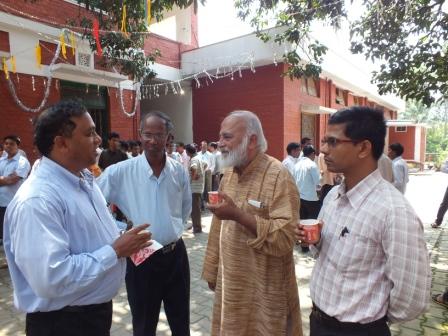
Moments of the Day


For More pictures Click the link given below
https://drive.google.com/folderview?id=0B_8FbLAFwzH-fjlNUk5ya29HZUVmZWQ5dWlxYkFFWmJBaHpYLTk1a0NEYXVFUVRXMGdXS28&usp=sharing


Blog Master
Fr. Raju Felix Crasta